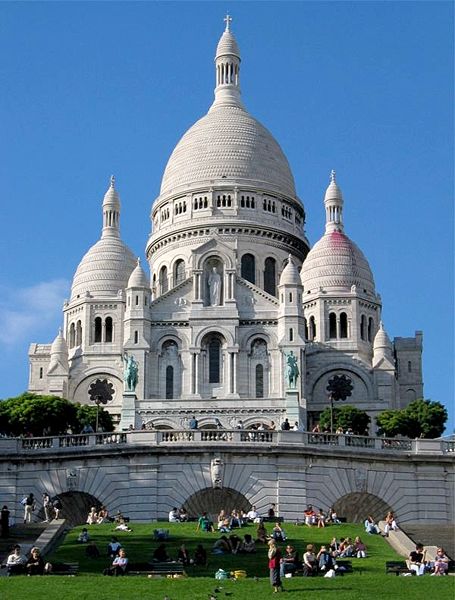
I intentionally skipped Day 6 because that was mine and Hunter's "day off" from being tourists, meaning we took barely any pictures. We slept in, stayed around my apartment, and just took a nice little break in the middle of the week. But on Thursday, which was Day 7, I had class in the morning, and Hunter started off the day by visiting the Invalides with Monica! In case you're not familiar with it, the Invalides is like a huge military museum, and the chapel in the picture above is where Napoleon's tomb is located.
 Here's Hunter posing by the bridge Alexander III, which is one of the more opulent bridges in the city (see the gold?).

Here's Monica posing by the bridge.

Hunter again!

The lovely Monica!

He looks so happy!
 Here's Monica standing in the courtyard holding Hunter's dossier! Remember how I made that self-guided tour for him? I put everything in this file along with maps of other parts of the city, things to read if he got bored, and things to know about the Invalides for when he went there with Monica!

Another happy picture of Hunter!
Then they went inside the chapel to see Napoleon's tomb.

Here's Monica standing in front of the tomb.

Hunter was apparently in awe over the domed ceiling.

The tomb by itself.
Pretty soon, my class ended and I met up with them in front of the chapel. Monica had to go, so I had Hunter to myself for the rest of the day!

I decided to get creative with the camera! Here's Hunter doing his best military poses.
 Hunter found a van with this fencing picture on it, and since I used to fence sabre, he wanted me to do my best lunge. Good thing my skirt was stretchy!

Here's my pensive look in front of the dome.

Couple picture!
After we played around at the Invalides for a while, we decided to go back to that bike rental company to rent bikes for the remainder of Hunter's visit (it's so much more fun going places on a bike than taking the metro!). We picked up the bikes really quickly because we had to be at the Paris opera house soon after that.
As I said before, I'm currently taking an opera course, and part of the course includes visits to the major opera houses in Paris- Opéra Garnier and Opéra Bastille. Opéra Garnier (also called the Paris Opera) is the house that everyone is familiar with because it's the older one and it's also referenced in the play "The Phantom of the Opera". Lucky for us, our class's visit to the Opéra Garnier was scheduled for the Thursday that Hunter was here, and my professor agreed to let me bring him along on the tour! It was amazing! We learned so much about the house's history, its architecture, and they even took us backstage to see people working and rehearsing. The only downside was that the entire tour was in French, and our guide spoke really quickly and without many pauses, so when I did finally get the chance to translate the information to Hunter, I basically had to remember several sections of the tour all at once.

Here we are inside the opera house!
 I had to take a picture of the ceilings! Our guide told us that the art in the house had a lot of influence from Greek mythology because the overall impression was meant to be that the opera is like a sacred temple of music that's blessed by the different gods pertaining to the Arts.
 Here's our group standing in the main entrance. We were told that when the house was built, the opera was more of a social event than just a time to go see a performance. Every public space was meant to be a sort of scene or backdrop for the people walking around, because back then, the real show was watching everyone else who came, similar to how we watch award shows on tv today (it's more about what the celebrities are wearing than who won something). This room was therefore one of the most important because it allowed the people to have a grand entrance, to watch others entering the house, and to mix and mingle.

Couple shot in the main entrance!
 The ballroom was also really important as a public space. It's similar to the Hall of Mirrors at Versailles, and was another area for people to mingle. Also, this room was meant to show off the wealth of the opera house and the Bourgeoisie, rivaling the opulence from the monarchy shown at Versailles.
 Here's Hunter admiring the artwork on the walls. I wonder what he was thinking in between the translations....

Couple shot in the ballroom!
 Here's a picture of one of the smaller rooms just outside the ballroom. The ceiling was meant to resemble the sun and how it shines for the world of opera. Another symbolic reference.
 Back to the main entrance! This is the grand staircase and it is the single most important part of the house because it's where you are first seen by society and where your opera experience begins. Below the staircase the lighting is dim and as you ascend the stairs, the lighting becomes brighter, so the overall effect is that to enter the temple of opera, you must ascend toward the heavens, toward the light, and become enlightened along the way. It was supposed to be a spiritual experience as well as impressive.

Here's what it looks like to ascend the staircase.
 This room was the entrance for the wealthier patrons. There are mirrors all around and from every angle so the patrons could check themselves before they entered the main entrance and the scrutiny of society's eyes upon them.Next, we went into the actual theater...
 Here's a picture of the ceiling and the chandelier. The ceiling is painted with references to some of the great operas in history, Like Romeo and Juliet for example. And the chandelier is amazing with no explanation!
 Here is some of the seating. We found out that the average seats will usually sell for around 70 euros. The nose-bleeds where you can't see anything run for around 30 euros. And if you're wondering why they chose red and gold for the color palate in the theater- it's because these colors are the most flattering for human flesh tones, so it was more for the audience to look appealing instead of the performers.
 Here's one of the box seats right next to the stage. Seats like these were the most preferred and the most expensive- not because you get a good view of the stage (the best seats for the view were actually in the balcony towards the back). It was because those places were easily seen by the rest of the audience. Just think, all you had to do to see the patrons in the box was shift your eyes slightly from the stage. Remember, the Opera was more of a place to see and be seen than anything else.

Here's Hunter glowing in the flattering reflection of the seat cushions!
 Here's the actual stage! Notice that it's at a slight incline towards the back. The reason why is because the incline allows for the performers and scenery in the back of the stage to be easily viewed just like the front of the stage.
 Here's a dance studio with some dancers rehearsing. Our guide told us that the studio is decorated similarly to the public spaces because this is where the patrons of the opera would come backstage to meet the performers. This room also has a promiscuous connotation because there were always rumors that the relationships between some of the patrons and the female dancers were less than professional. Plus, there are peepholes in various places in the walls so that stage workers could peer in on the dancers while they were changing. Those peepholes are still there.Now, if you've ever seen or are just familiar with the story of the "Phantom of the Opera", you know about the rumor of the underground lake below the opera house. Well, the rumor is partly true since there is actually a water reservoir below the house. But the best part is that we got to see it!
 We had to go several stories below the house to see the water, and there were cages over the openings so you couldn't fall in.
 As you can see, some of the floor is usually wet, so they had boards for us to walk over. So here's the story behind the water:As the opera house was in construction, one of the major obstacles was the swampy foundation and the underground water they were building over. Charles Garnier, who was the architect that the house was named for, came up with the genius idea to utilize the problem as a solution. The major problem with opera houses in general is that the weight is unevenly distributed throughout the building. The heaviest section is the stage (in the middle), and the lighter sections are the public spaces and the administative offices at the back, so the ultimate effect would be that the whole house would sort of cave in at the center. Garnier decided to use the underground water to prevent this by creating a reservoir and using the water to help balance the structure. The plan worked, and the design was used for other opera houses around France. Another benefit of having an underground reservoir: because the decorations were so flammable and because of the gas lighting, there was always a tremendous risk of fire. However, with a ton of water close by, you have a quick way to stop the fire before it spreads.

Here I am by the reservoir!
That was the last bit of the tour. I really enjoyed it, and I'm excited for the next our at the Opéra Bastille!
After the tour, Hunter and I rode our bikes back to my apartment.

Here's my glamour shot of the day as we were riding through the city!

Funny face by the Seine!
(I think the face was because I was on a bike with a skirt on that kept riding up. I got a good bit of attention that day, ha ha...)
We rode through the Bastille on the way home, and we found part of a huge protest along the way.

It was crazy! As you can see, there were people hanging off the Bastille monument and the whole square was shut down (the road behind us is a round-about that's usually packed with cars).

There were so many people that we couldn't ride our bikes and it took a while to navigate through the crowd on foot. It's hard to see, but here I am in the middle with my bike.
I'm not sure exactly what they were protesting that day and exactly who was participating, but I know that Sarkozy's reforms are upsetting a lot of people here. Protesting and strikes are usually a normal occurrence here in France (they call it
descendre dans la rue, meaning to descend into the streets), but it seems to be a lot more frequent lately.
I found a BBC news article that explains what happened that Thursday pretty well, and has links that give a little insight as to what's been fueling the unrest here if you want to know more:
 Unfortunately, we didn't get to spend much time together at all (just a few hours really), because we met up the afternoon before her flight back to London, but we still had a good time! Let's see... we talked about how her experience abroad was, how mine is going, how our families are, we poked fun at our grandmothers a little (don't worry, it wasn't too bad, ha ha), and so on. I took her and her friend to see the Arc de Triomphe and the Champs Elysées and made sure she got to Charles de Gaulle airport on time. So it was brief, but I really enjoyed meeting her.
 We ended up in the Tuileries gardens, and here's a picture of me by the north side. See how green the grass is now? Spring has definitely hit Paris.
 Me and Monica!
 We found this bar tucked away under this old building called "The Highlander". Sounds cool, right?
 Here I am standing in the alley where the bar was.
 And here we are in the bar. You can see the game going on in the background. The match was really close the whole game, and it wasn't until the last few minutes that Liverpoole scored and won. I was quite surprised by how much I enjoyed it all! I was yelling at the tv almost as much as Monica even. We also met this British couple and a French man in the bar who were also following the match, and it was fun talking with them about how poorly Liverpoole was doing and so on. I didn't know what was going on half the time, but it was still interesting.
 Here we are having fun watching the match! This made me really want to go see a live match at Stade de France.
 Remember how in Amsterdam they had these pee deflectors on the corners of government buildings? We found them in Paris too! They weren't as high tech, though, so I was a bit disappointed.
 We found a lot of couples there passing time, and it made me wish Hunter was still here to see it too.
 I found this greenspace where everyone was soaking up the sun, and I decided to join!
 Here I am listening to music and enjoying my sandwich!
 This was our view!
 This was our picnic! One of the girls brought some homemade bread, which was so so good.
 Me and Monica relaxing on the lawn!
 Here's me, Monica, and our friend William!


 Posts